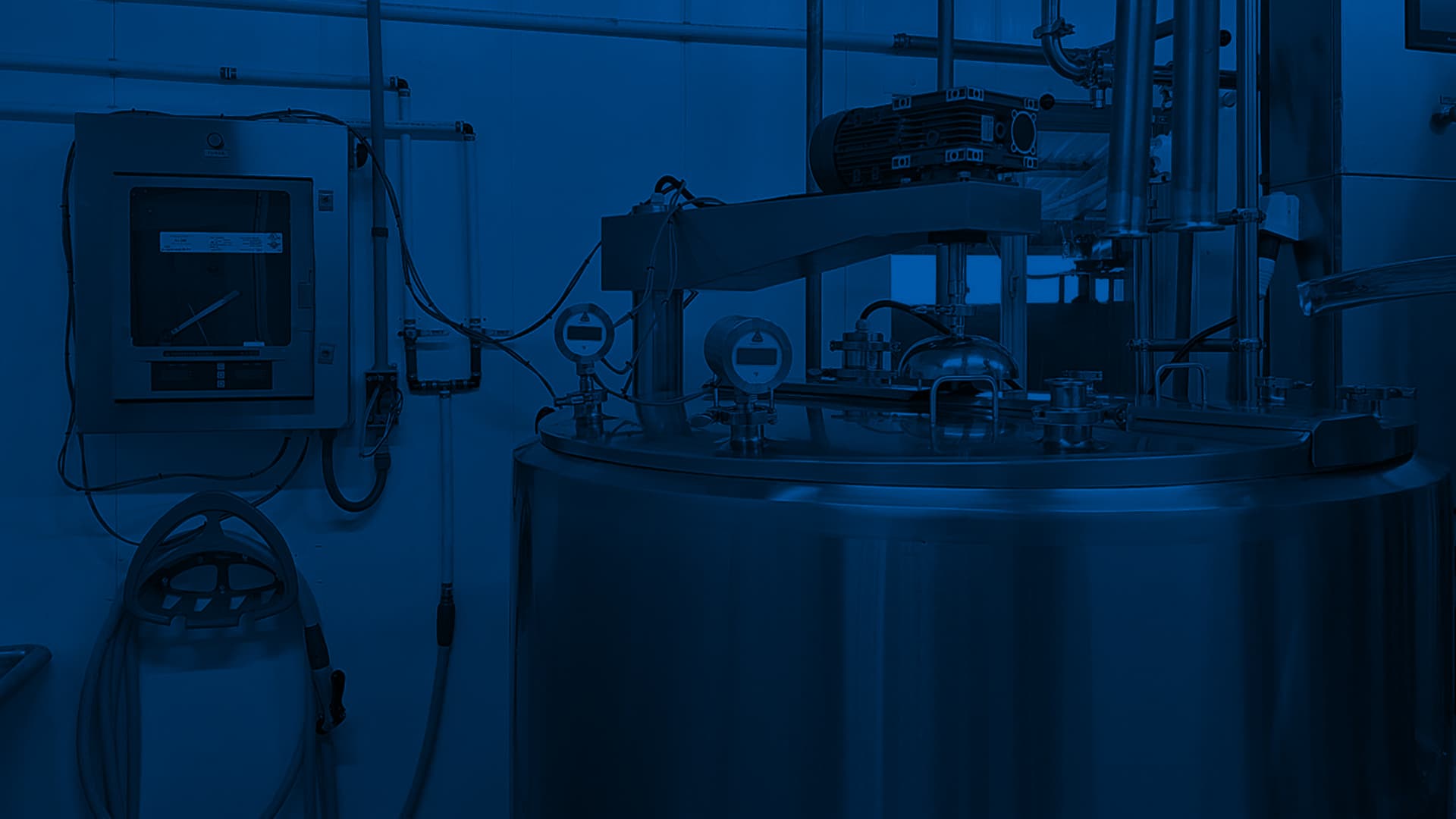
In almost all processes in dairies, breweries, and in the food, beverage and pharma industry, pressure gauges contribute to ensuring the efficiency of the processes, guaranteeing constant product quality, avoiding downtimes,...
Hygienic Pressure Gauges for Food, Beverage, and Life Sciences
Applications for Hygienic Pressure Sensors
Pressure instruments serve various applications across industries:
Process pressure control:
In many production processes or in CIP/SIP processes, inline pressure sensors ensure that the specified positive or negative pressure values in pipes, tubes, lines, process vessels, storage tanks, bioreactors or other containers is maintained. Pressure transmitters and manometers with switching output can report the deviation to the PLC via an alarm signal, so that an automatic, immediate reaction or protective measure can be triggered.
Hydrostatic level control:
With pressure sensors, the level in containers can be determined and transmitted with the highest precision where other level measurement techniques are not possible or not precise enough due to tank size, design, materials, media or other reasons.
Hydrostatic volume control:
Intelligent pressure sensors with integrated tank linearization can even go one step further: the combination of level, tank geometry, density compensation and temperature compensation allows the volume or mass in pounds, gallons, % to be transmitted directly and with maximum precision at any time and for any medium.
Differential pressure control:
By equipping a pressure sensor with two sensor stems and signal converters the parallel detection of two pressure values is possible. This allows for the precise measurement of the differential pressure in a pressurized vessel and thus at same time both the precise metering of the level and the monitoring of the head pressure in a pressure tank, such as a fermenter tank, a sterile tank or a juice storage tank. This digital measuring system is easy to install, does completely without capillaries, is reliable and safe. It can be used to monitor the risk of contamination due to a drop in pressure or the post-fermentation in juice production.
Designs of hygienic pressure sensors
Electronic pressure transmitters:
work with an internal piezoelectric signal converter. They can indicate the measured value in a display, transmit it to the PLC or process it in their intelligent electronic unit itself with other measured data such as temperature. This means that for any requirement a suitable measurement technology with convenient data detection, processing and transmission is available. Another differentiation is the material used for the pressure diaphragm or pressure cell.
Hygienic Pressure Gauges
Hygienic design / Hygienic materials
The pressure meters are made of the highest quality materials. Depending on type and intended application, the following materials and surfaces can be selected:
Components in contact with the medium: Stainless steel 1.4404 (316L) / 1.4435 (316L)
Pressure cells: Stainless steel 1.4404 (316L) / 1.4435 (316L) / C276 Hastelloy.
Surface roughness up to Ra≤8 microinches (electropolished)
A 3.1 material certificate is available for pharmaceutical applications.
Due to their extremely robust and durable design, the sensors can withstand even the highest mechanical stresses such as vibrations and pressure shocks, which occur repeatedly in many real-world applications, and permanently ensure the highest precision.
Process adaptations / Installation
Anderson-Negele’s Longlife technology significantly enhances measurement sensitivity and durability. Our wear-free mechanical devices deliver ±0.25% accuracy for years, supported by a robust hydro-mechanical damping system that protects against severe pressure surges. The high-quality sensor materials and precise in-house welding ensure a long service life, while the recessed diaphragm design prevents handling damage.
The gauges feature a two-point zero and span adjustment, extending service life and reducing early replacements, which contributes to a favorable cost of ownership. Practical for long-term use, these gauges are designed for robustness with autoclavability, CIP/SIP capability, surface roughness of Ra ≤ 0.2μm, and temperature resistance up to 165°C. The IP66-rated, hygienic one-piece design is easy to clean, and the large, clear display is available in 63 mm and 90 mm diameters, with adjustable pressure scales. The electronic version includes a backlit LCD display for easy reading.
The use of USP Class VI compliant pressure transmitting fluid prevents contamination from diaphragm damage, while the stainless-steel diaphragms offer extended life and reduced fracture risk.
A large number of different process adaptations ensure great flexibility with regard to installation in new plants and retrofitting in existing processes, tanks or pipes. In addition to pressure sensors with hygienic thread, tri-clamp connection or even O-ring seals, there are also variants that can be installed in pipelines with smallest nominal diameters from 1/4″.